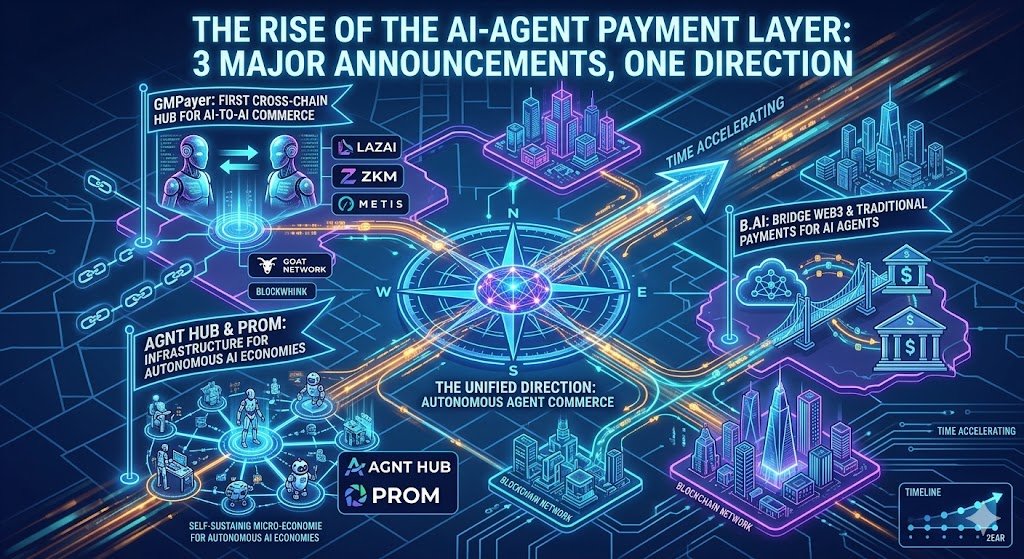
A new wave of crypto infrastructure projects is racing to build the payment layer for autonomous AI agents, and the moves are happening faster than most people have noticed. LazAI, ZKM, Metis, and GOAT Network recently unveiled x402 GMPayer, billed as the first cross-chain payment hub built specifically for AI-to-AI commerce.
Around the same window, B.AI launched a system to bridge Web3 and traditional payments, and AGNT Hub partnered with PROM to build infrastructure for what they describe as autonomous AI economies. Three announcements. One direction.
The pattern is hard to miss once you see it. AI agents are no longer just answering questions. They are starting to act, buy, and settle on their own. And the rails they are settling on are crypto.
What x402, GMPayer, and the New AI Agent Stack Actually Do
GMPayer is built on the x402 standard, which lets AI agents make trustless payments across multiple blockchains in multiple currencies, with no human in the middle and no traditional intermediary. The project’s pitch is that agents can transact directly with each other the moment a service is needed, without setting up accounts, signing in, or waiting on card networks.
B.AI takes a slightly different angle. It connects Web3 payment flows to traditional finance, so an agent can settle a stablecoin payment on-chain while the receiving party gets value through systems they already use.
AGNT Hub and PROM are stacking another layer on top, building the broader infrastructure agents need to discover services, negotiate terms, and operate inside a shared economic environment.
Read together, these are not three separate stories. They are pieces of the same stack: payments, settlement bridges, and coordination. The same stack the internet had to build before e-commerce worked.
Why Crypto, and Why Now
The reason AI agents have ended up on blockchain rails is structural, not fashionable. Traditional payment systems were built around human checkout. A person types a card number, logs into an account, and clicks approve. An AI agent does not have an inbox. It does not have a credit history. And when it needs to pay half a cent for an API call, the card network economics simply do not work.
Stablecoins on fast chains solve all of this at once. Payments can be sub-cent. Settlement is instant. There are no accounts, just wallets. An agent can sign a payment inside its own logic, batch dozens of them, and keep moving. The chain runs 24/7, which matches the way agents operate. They do not sleep. They do not wait for business hours.
This is why projects like GMPayer matter beyond the announcement itself. They are building the cross-chain layer that lets agents pay across whichever network the counterparty happens to live on. Without that layer, every blockchain becomes a walled garden. With it, agents can move freely.
The Shift from Chatbot to Economic Actor
There is a real change in what AI agents are doing this year, and it is the change that pulls all of this together. In 2024, large language models mostly responded. You typed something. The model wrote something back.
By 2025 and into 2026, agents started doing the work themselves: searching, comparing, calling APIs, paying for compute, and finishing tasks without supervision.
That shift is what turned payments from a “nice to have” into the bottleneck. An agent that needs to pay for data, rent a GPU for ten seconds, or hire another agent for a sub-task cannot stop and ask a human every time. The whole point of an autonomous agent is that the loop closes without you. If the payment layer cannot keep up, the loop breaks. Crypto closes that loop, which is the entire reason this corner of the market is moving.
Honestly, this is the part I keep thinking about. Agents are starting to transact while their users are asleep. Some of them are already paying other agents for tasks no human asked them to break down. Useful, sure. A little strange, too.
Where the Broader Market is Heading
The announcements from LazAI, ZKM, Metis, GOAT, B.AI, and AGNT Hub are early signals of a much larger reshaping of crypto’s role in the economy. If agents become the primary users of digital payment rails, then stablecoins stop being a trader’s tool and become the default settlement layer for a new kind of commerce. One where buyers and sellers may both be software.
That changes what crypto projects compete on. Speed and fees matter more. Cross-chain interoperability stops being a developer convenience and becomes a survival issue. And the chains that win the agent payment share early are likely to keep it, because agents tend to standardize on whatever works the first time.
Identity is the other shoe waiting to drop. If agents can pay, the next question is whether a given agent should be allowed to pay for a given thing, on whose authority, and with what limit. The infrastructure being built today by GMPayer and its peers handles the payment side cleanly. The permission side is still being figured out, and that is probably the next round of announcements you will see in this space.
What to Watch Next
The clearest tell that this trend is real is not the partnership announcements themselves. It is the speed at which they are stacking. GMPayer, B.AI, and AGNT Hub all moved in a tight window, and each one targets a different layer of the same stack. That is what an ecosystem looks like when it is forming, not when it is being marketed.
A few things worth keeping an eye on in the months ahead. Whether more chains add native support for agent-to-agent payment standards. Whether traditional payment companies start integrating with the same protocols. Whether the agent platforms themselves start defaulting to crypto rails out of the box.
If those three things keep happening together, the agent economy stops being a thesis and starts being infrastructure people use without thinking about it.
Conclusion
The story buried inside these announcements is simple. AI agents need to pay. Traditional rails cannot carry them. Crypto can. LazAI, ZKM, Metis, GOAT, B.AI, and AGNT Hub are not chasing the same hype cycle as last year’s tokens. They are building the plumbing for a different kind of user, one that does not have a wallet on a phone, but a wallet inside its own code. If they get this right, the agent economy stops being a forecast.