Secury Wallet has officially stepped into the market as a next-generation non-custodial mobile wallet, positioning itself as a response to long-standing problems in digital asset management.
The launch focuses on a simple message. Web3 does not need to feel complex or risky. By combining security, multi-chain access, and user-first design, Secury Wallet aims to make managing crypto assets feel closer to using a traditional financial app.
As the market continues to mature, products that remove friction are expected to play a major role in shaping the next phase of adoption.
A Unified Wallet for a Fragmented Market
One of the biggest challenges in crypto today is fragmentation. Users often manage multiple wallets, switch between apps, and navigate different interfaces just to interact with various blockchains.
Secury Wallet addresses this by offering a single mobile platform that supports major networks such as Bitcoin, Ethereum, and leading EVM-compatible chains including BNB Chain, Polygon, and Avalanche. This unified approach allows users to manage assets across ecosystems without unnecessary switching.
By simplifying access, the wallet reduces barriers for everyday users. For the broader market, this signals a move toward consolidation, where convenience becomes a competitive advantage rather than an afterthought.
Non-Custodial by Design, Security at the Core
At the heart of Secury Wallet is a fully non-custodial architecture. Users retain full control over their private keys and funds at all times, with no access granted to the platform itself.
This model removes central points of failure that have historically exposed custodial services to hacks and misuse. Instead of trusting a third party, users remain the sole owners of their digital assets.
Security is reinforced through multiple layers working together to protect funds and data. Sensitive information stored on the device is encrypted using AES-256 standards, commonly used by banks and government institutions.
Additional protection comes from biometric authentication, including fingerprint scanning and Face ID, with optional two-factor authentication for transaction approval. All smart contracts and integrated DeFi protocols are audited by independent security firms to reduce the risk of vulnerabilities.
Built for Everyday Users, Not Just Experts
While security is critical, adoption depends heavily on usability. Secury Wallet places strong emphasis on a clean, mobile-first design that removes technical friction.
The interface is built to feel familiar, allowing users to send, receive, and manage assets without deep technical knowledge. This approach aims to bridge the gap between traditional finance and decentralized systems.
By lowering the learning curve, Secury Wallet targets a wider audience. For the future market, products that prioritize ease of use are likely to attract users who have previously remained on the sidelines.
Technical Foundations Powering Long-Term Growth
Behind the simple interface lies a robust technical framework designed for scalability and flexibility.
Secury Wallet uses the Hierarchical Deterministic standard, known as BIP-39, for key management. With a single 12-word seed phrase, users can generate and manage multiple addresses across different blockchains. This simplifies backup and recovery while strengthening overall security.
Cross-chain interoperability is another key feature. Integrated bridging protocols and atomic-swap technology allow users to move assets between chains directly within the app. This removes reliance on external tools and reduces exposure to third-party risks.
Key components of the platform include:
- Fully non-custodial key ownership
- Multi-chain support across major networks
- Built-in cross-chain transfers and swaps
- AES-256 encrypted local data storage
- Biometric and two-factor authentication
- Audited smart contracts and integrations
Together, these elements create an infrastructure designed to support long-term use rather than short-term trends.
The Role of the $SEC Token and Market Outlook
At the center of the ecosystem is the $SEC token, which powers rewards, staking, and future governance. The tokenomics are structured to encourage community participation while supporting sustainable growth.
To build trust, the team’s 5 percent token allocation is locked for one year. This lock-up aligns the team with long-term development goals and reduces concerns around short-term exits.
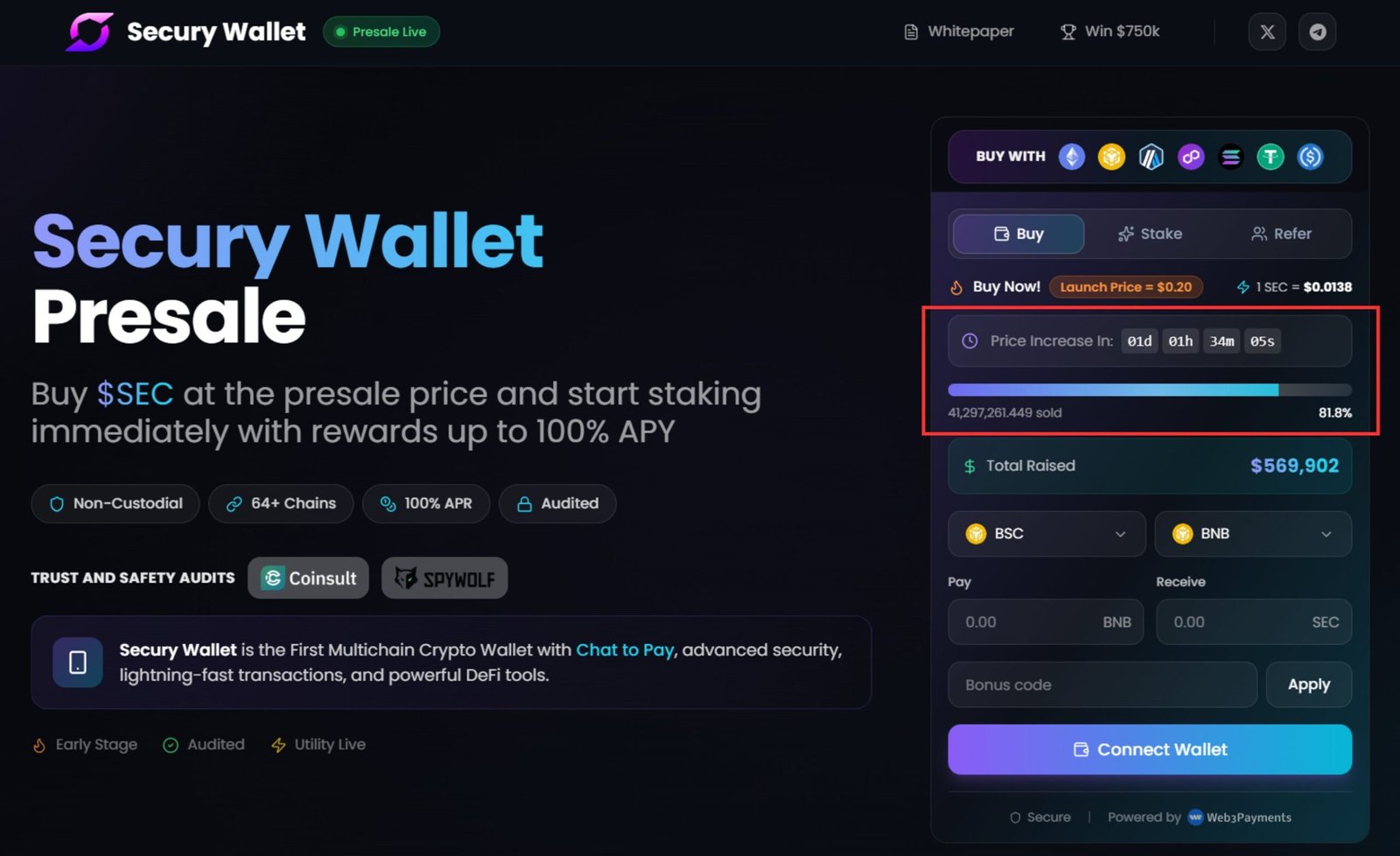
Current presale data shows steady progress. The project is in stage three, with the token priced at $0.0151 and the next stage set at $0.0166. So far, approximately $787,613 has been raised.
From a market perspective, wallets that integrate tokens with real utility may play a larger role in shaping user behavior. As governance and rewards become more common, user-driven ecosystems are expected to gain influence.
Looking ahead, Secury Wallet reflects a broader trend toward tools that combine security, simplicity, and interoperability. If adoption continues to favor platforms that reduce complexity, solutions like this could help define how the next wave of users enters Web3.
As the crypto market moves toward maturity, products focused on trust and usability are likely to influence not just individual users, but the overall direction of decentralized finance and digital asset management.