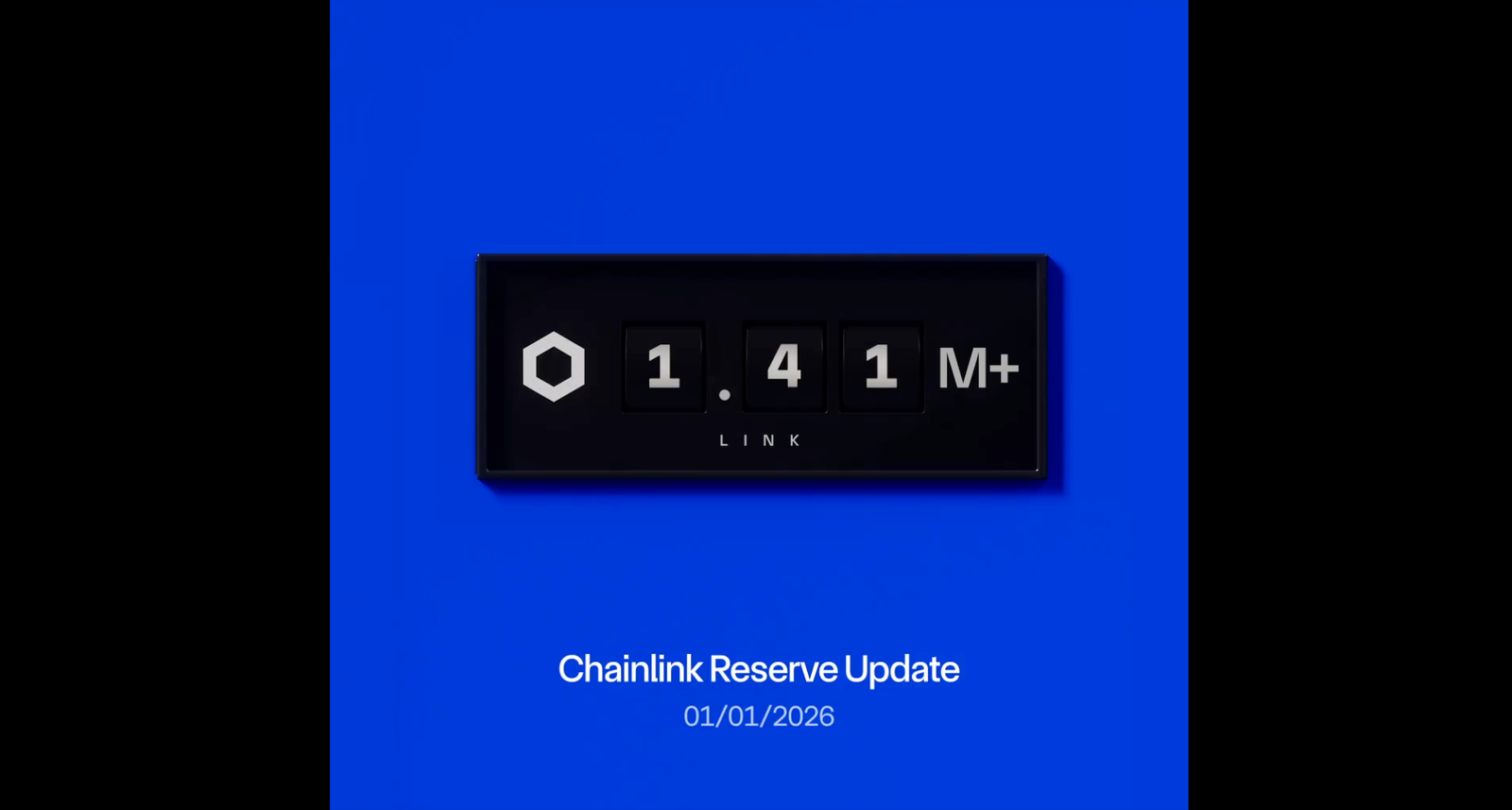
Chainlink has announced a major reserve update, confirming that its onchain Chainlink Reserve has accumulated an additional 94,267.77 LINK tokens, pushing total holdings to 1,416,379.61 LINK.
The update highlights a steady inflow of LINK generated from both offchain enterprise revenue and onchain service usage. This development reinforces the platform’s long-term strategy to support network sustainability through real revenue rather than short-term token incentives.
The Reserve was launched six months ago as part of a broader economic upgrade. Its purpose is simple in concept but significant in impact: convert actual demand for Chainlink services into a growing strategic reserve of LINK held onchain.
What The Latest Chainlink Reserve Update Shows
The newly shared figures confirm that the Chainlink Reserve continues to grow at a measured and transparent pace. The addition of more than ninety four thousand LINK reflects consistent revenue conversion rather than one-time inflows.
The platform states that the Chainlink Reserve is funded by revenue generated when enterprises and applications use its services. These revenues may originate from traditional offchain payments or directly from blockchain-based usage, both of which are converted into LINK.
Key details from the update include:
- The Reserve accumulated 94,267.77 LINK in the latest update period
- Total holdings now stand at 1,416,379.61 LINK
- No withdrawals are expected for multiple years
- The Reserve operates fully onchain with visible analytics
By keeping the Chainlink Reserve on Ethereum and publishing its contract address, Chainlink allows anyone to independently verify balances. This transparency is designed to build trust among developers, institutions, and the wider crypto community.
Why They Created A Strategic LINK Reserve
The idea behind the Chainlink Reserve is rooted in long-term planning rather than short-term market reactions. Chainlink has already generated hundreds of millions of dollars in revenue, much of it paid offchain by large enterprises.
Instead of leaving these revenues disconnected from the token economy, Chainlink designed a system to convert them into LINK. This directly ties real-world adoption to the network’s core asset.
The Chainlink Reserve serves several purposes at once:
- It creates a long-term pool of LINK backed by actual service demand
- It aligns enterprise usage with the health of the network
- It reduces reliance on inflation-based incentives
- It strengthens Chainlink’s economic foundation
Chainlink has emphasized that the Reserve is not intended for frequent use. Instead, it is expected to grow over time as adoption expands across decentralized finance and traditional finance sectors.
How Payment Abstraction Converts Revenue Into LINK
At the center of the Reserve system is Chainlink Payment Abstraction, an onchain mechanism that simplifies how users pay for services. Rather than forcing every user to hold LINK, Payment Abstraction allows payments in different assets.
These payments are then automatically converted into LINK through onchain processes. This reduces friction for users while still ensuring LINK remains the settlement asset for Chainlink services.
Payment Abstraction works by combining several Chainlink technologies:
- CCIP consolidates fees from multiple blockchains onto Ethereum
- Automation triggers conversions without manual actions
- Price Feeds provide accurate token pricing during swaps
Uniswap V3 is currently used as the primary decentralized exchange for conversions due to its deep liquidity and permissionless design. Chainlink has stated that additional exchanges may be integrated in the future to improve efficiency and protection.
This system ensures that whether revenue starts offchain or onchain, it can still contribute to the growth of the Reserve in a consistent and verifiable way.
Chainlink’s Broader Economic Model And Platform Strength
The Chainlink Reserve is only one part of Chainlink’s wider economic structure. Over the years, Chainlink has expanded far beyond price feeds into a full platform supporting data, interoperability, automation, and compliance.
Today, Chainlink secures tens of trillions of dollars in transaction value across more than sixty blockchains. Its price feeds alone hold a dominant share of the oracle market, making them a core dependency for decentralized finance.
Chainlink’s economic pillars include:
- Enterprise integrations that generate offchain revenue
- Usage-based payments tied directly to service consumption
- Revenue-sharing models with major protocols
- Cost reductions through architectural upgrades
New developments like the Chainlink Runtime Environment are designed to reduce operating costs while maintaining high security standards. These efficiencies help ensure that more revenue can be retained and converted into LINK rather than spent on infrastructure overhead.
What This Means For Chainlink’s Long-Term Outlook
The steady accumulation within the Chainlink Reserve sends a clear message about the project’s direction. Instead of focusing on short-term incentives, Chainlink is building an economy supported by real usage and enterprise demand.
As more institutions adopt blockchain technology and tokenization expands, Chainlink expects demand for its services to grow. This demand feeds directly into Payment Abstraction, which in turn strengthens the Reserve.
Chainlink has stated that the Reserve is designed to complement existing initiatives, not replace them. Together, these systems aim to create a sustainable oracle network capable of supporting global financial infrastructure.
With over 1.4 million LINK now held in the Reserve and no planned withdrawals in the near future, the latest update highlights Chainlink’s commitment to long-term stability, transparency, and growth driven by adoption rather than speculation.