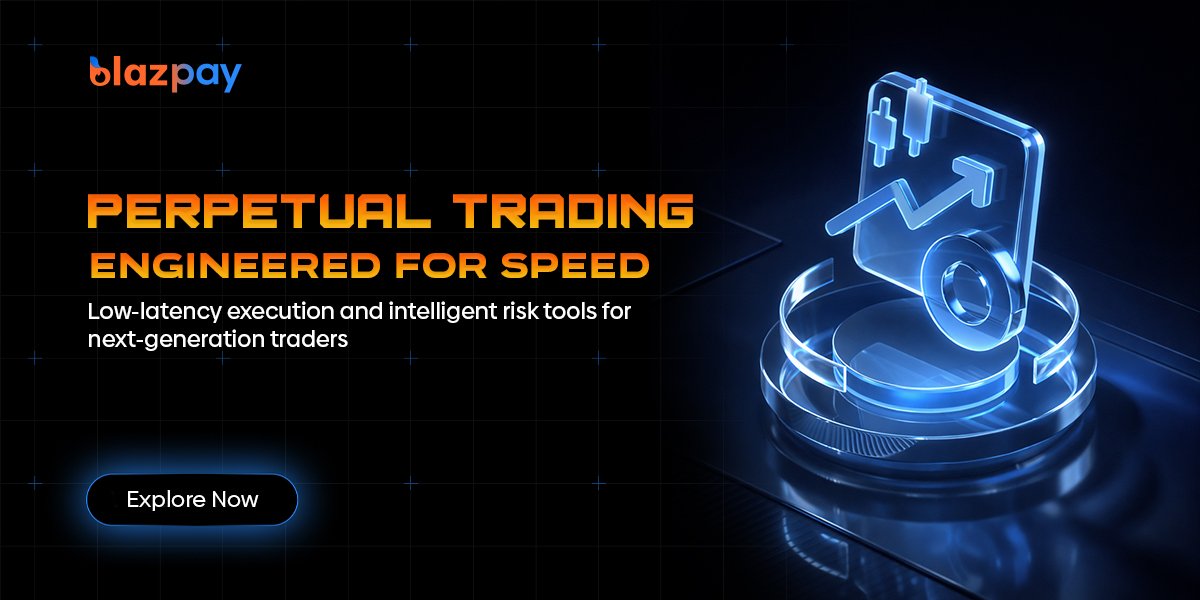
Blazpay has announced the rollout of its new perpetual trading infrastructure, designed to deliver faster execution, intelligent risk management, and full user control during volatile market conditions.
The update positions Blazpay as a serious infrastructure provider in the growing perpetual futures market, where speed, transparency, and reliability often decide outcomes for traders. By focusing on low-latency execution and self-custody, the platform aims to address long-standing concerns around centralized risk and delayed trades.
As crypto markets continue to mature, this development highlights how infrastructure-level innovation may define the next phase of trading adoption and stability.
Why Speed Is Becoming Critical in Crypto Trading
Market speed has always mattered in trading, but in crypto, it has become essential. Prices can shift sharply within seconds, especially during major news events or periods of high leverage activity.
Blazpay’s new system is engineered to reduce latency at the execution layer, ensuring that trades are processed on-chain with minimal delay. This design helps traders act on market signals without losing value to slow confirmations or inefficient routing.
In the long term, faster and more reliable execution can improve overall market health. When traders trust that systems respond accurately and quickly, it reduces panic-driven behavior and unexpected liquidations.
For the broader market, infrastructure that prioritizes speed may encourage professional and institutional participants to engage more confidently with decentralized platforms.
Building Perpetual Trading Without Giving Up Control
One of the defining features of Blazpay’s perpetual trading infrastructure is its commitment to self-custody. Users retain control of their assets rather than handing funds to a centralized intermediary.
This approach addresses a major concern that emerged during previous market cycles, where centralized failures led to frozen withdrawals and unexpected losses. By keeping execution on-chain, Blazpay aims to align trading performance with user ownership.
The platform also emphasizes transparency, allowing traders to understand how leverage, funding, and execution behave under different market conditions. This clarity can help users make informed decisions instead of relying on opaque systems.
Over time, self-custodial trading models may become a standard expectation rather than a niche option, reshaping how traders evaluate platforms.
AI-Driven Risk Management Enters the Spotlight
Risk management has become one of the most discussed topics in perpetual trading. High leverage can amplify gains, but it can also accelerate losses when markets move suddenly.
Blazpay integrates AI-driven systems to monitor trading conditions and help manage risk more intelligently. These systems are designed to respond dynamically, rather than relying only on static parameters.
This shift could influence how traders approach leverage in the future. Instead of focusing purely on maximum exposure, users may begin prioritizing platforms that offer smarter safeguards.
From a market perspective, widespread adoption of AI-based risk tools could reduce cascading liquidations and extreme volatility during stress events.
Key Capabilities Shaping the Trading Experience
Blazpay’s perpetual trading infrastructure brings together several core capabilities designed to improve usability and performance.
These elements are positioned as building blocks for a more resilient decentralized trading environment:
- Low-latency on-chain execution that reduces delays during fast market moves
- Advanced leverage controls aimed at improving precision and risk awareness
- AI-assisted risk monitoring that adapts to changing market conditions
- Transparent mechanics that allow users to understand how trades are handled
- Self-custody architecture that keeps asset control with the trader
For future markets, platforms that combine these features may set expectations for what decentralized trading should deliver at scale.
Blazpay’s Broader Vision for DeFi and Trading
Beyond perpetual trading, Blazpay describes itself as a comprehensive AI and DeFi platform for both users and businesses. Through its BlazHub ecosystem, the company connects trading, rewards, and on-chain engagement under a unified experience.
This broader vision suggests that perpetual trading is not being developed in isolation. Instead, it is positioned as one component within a wider financial ecosystem that includes incentives, analytics, and cross-chain activity.
As DeFi continues to evolve, integrated platforms may outperform single-purpose tools. Users increasingly expect seamless movement between trading, earning, and portfolio management.
For the market, this signals a shift toward ecosystem-driven growth rather than fragmented applications competing for attention.
What This Means for the Future Crypto Market
The launch of Blazpay’s perpetual trading infrastructure reflects deeper changes underway in crypto markets. Traders are demanding tools that combine performance with protection, without sacrificing decentralization.
If platforms like Blazpay succeed, the future market may see reduced reliance on centralized exchanges for advanced trading. This could redistribute liquidity across on-chain venues and strengthen decentralized market resilience.
AI-driven risk management may also become a baseline expectation. As these systems mature, they could help smooth volatility cycles and improve confidence during uncertain conditions.
Ultimately, infrastructure that prioritizes speed, transparency, and self-custody may shape how the next generation of traders enters the market. In that environment, platforms built for precision rather than hype are likely to influence the direction of crypto trading for years to come.